In Brazil, the rule that binds your company is NR-35. IRATA and SPRAT are excellent technical references, but Annex I of NR-35 points to the national technical standards.
In practice, all three ask for almost the same things: certified technicians, two ropes, inspected equipment and a rescue plan. The differences that matter most day to day are the deadlines, the hours and who signs each record.
This guide compares the three systems side by side and shows what your company needs to be able to prove in each one.
Who is who
Not every acronym here is a standard. ABENDI and ANEAC are organizations; the rules are in NR-35 and the NBR standards.
| Acronym | What it is | Role in rope access |
|---|---|---|
| NR-35 | Brazilian Regulatory Standard for work at height | Mandatory above 2 m where there is a fall risk. Annex I covers rope access and Annex II covers anchorage |
| ABNT NBR 15475 | Technical standard for qualifying and certifying people | Defines levels N1, N2 and N3, the exams and the hours record (DRAPC) |
| ABNT NBR 15595 | Technical standard for procedures | Defines how to apply the method safely on the job |
| ABENDI | Association and certification body | Certifies people under the NBR standards. It was the first body accredited by Inmetro for rope access |
| ANEAC | Brazilian national association of rope access companies, founded in 2007 | Brings together companies in the sector. Publishes procedure NAC-005 and issues the DRAPC for its own system |
| IRATA | International association, created in the UK | Maintains the ICOP code of practice and the TACS certification scheme, with ISO/IEC 17024 accreditation |
| SPRAT | Technicians’ association with a strong presence in North America | Publishes the Safe Practices and the certification requirements |
NR-34 also refers to the same NBR standards for shipbuilding and ship repair work.
Side by side
All three systems have three levels, 3-year validity and two independent ropes. The numbers below are the published minimum requirements.
| Criterion | Brazil (NR-35 + NBR) | IRATA | SPRAT |
|---|---|---|---|
| Force of the rule | Legal: NR-35 is mandatory | Voluntary under UK law, mandatory for members | Association standard; stricter local law prevails |
| Base documents | NR-35 Annex I, NBR 15475, NBR 15595 | ICOP and TACS | Safe Practices and Certification Requirements |
| Level 1 to 2 | 12 months and 1,000 h (24 months without a high school diploma) | 12 months and 1,000 h | 6 months and 500 h |
| Level 2 to 3 | 30 months and 2,500 h | 12 months and 1,000 h | 6 months and 500 h |
| Minimum to reach level 3 | 42 months and 3,500 h | 24 months and 2,000 h | 12 months and 1,000 h |
| Hours record | DRAPC, signed by the N3 | Logbook, signed by the L3 supervisor | Entries of up to 2 weeks, verified by another person |
| Minimum team | 2, one of them a supervisor | 2, one of them an L3 | 2, one of them a supervisor |
| Who supervises | N3; remote on land, with an N2 on site, depending on the risk analysis; on site over water | L3 always on site | Preferably L3; L2 only on simple work, under set criteria |
| Pre-use inspection | Mandatory | Mandatory, before first use each day | Mandatory, before each use |
| Periodic inspection | At least every 6 months | Every 6 months or under a competent person’s scheme | Documented at least once a year |
| Inspection record | On purchase, at each periodic inspection and on rejection | Every detailed inspection, plus use and maintenance | History from purchase to retirement (recommended) |
| Defective item | Reject, destroy and discard | Withdraw from service and quarantine | Withdraw from service until confirmed safe, or retire |
| Rescue | A plan for each work front | A specific plan within each method statement | A plan within the access work plan |
| Before starting | Risk Analysis; Work Permit for non-routine activities | Pre-work analysis, risk assessment and method statement | Access work plan, reviewed every shift |
| Wind | Stop above 40 km/h; documented exception up to 46 km/h | Covered in the risk assessment | Covered in the risk assessment |
| Company audit | No general requirement today | Every 3 years for members | Company runs its own program, with a named administrator |
Where the differences matter
Inspection: 6 months is the deadline that counts. The general part of NR-35 says 12 months, but Annex I sets 6 for rope access, and the annex prevails for this activity. A company working to SPRAT’s annual record or to the general part of NR-35 may fall short of the rule.
Career: the Brazilian path to N3 is the longest. It takes 3,500 hours, against 2,000 for IRATA and 1,000 for SPRAT. That makes each technician’s hours record valuable: without a signed DRAPC, the hours do not count toward the next level.
Supervision: IRATA is the strictest. It requires an L3 on site on every job. Brazil allows remote N3 supervision on land, with an N2 present. That decision has to be justified in the risk analysis.
Company: only IRATA audits today. Member companies go through an independent audit every 3 years. In Brazil, NR-35 does not create this audit, but it does require the organization to keep its documentation for at least 5 years.
Do IRATA or SPRAT certificates count in Brazil?
On their own, they do not meet the text of Annex I. The standard requires certification under national technical standards, and the Ministry of Labor manual points to NBR 15475, with a body accredited by Inmetro.
That does not take away the value of international certification. Petrobras adopted the IRATA method in 2001, before any national standard existed, and there are Brazilian IRATA member companies. Many contracts, especially international ones, may ask for more than one certification, so check what each client requires.
What may change: Bill 4911/2023
Bill 4911/2023 regulates the profession of Rope Access Technician. The lower house approved it in February 2025 and it moved to the Senate. It is not law yet. If it passes as written, companies would have to:
- Obtain certification as an operator, with an audit within 12 months, renewed after 1 year and then every 2 years.
- Have an equipment inspector with at least 24 hours of training.
- Keep traceability for each item: purchase date, invoice and expiry control.
- Keep an inspection sheet for each item, signed by the inspector: 6 months for textile and 12 months for metal.
- Mark each item with a reference number linked to its sheet.
- Hold personal accident and civil liability insurance.
For technicians with international certification, the bill requires a certificate from a body accredited under ISO/IEC 17024, 16 hours of training on NBR 15475 and a sworn translation. The direction is clear: more records, each with an owner and a date, per item and per person.
What you need to be able to prove
Whatever the system, the audit question is the same: where is the record? Use this list to test your operation.
People
- A valid certificate for each technician, with the expiry date under control.
- An Occupational Health Certificate (ASO) showing fitness for work at height.
- Formal authorization from the company. A certificate alone does not authorize anyone to work.
- Hours recorded in the DRAPC or logbook, with a signature.
Equipment
- Individual marking and traceability for each rope and item of equipment.
- An inspection record on purchase, at each period and on rejection.
- A record that the rejected item was destroyed and discarded, so it cannot return to a kit by mistake.
- A valid Certificate of Approval (CA) on PPE.
Each job
- A Risk Analysis before starting.
- A Work Permit for non-routine activities, closed and filed. NR-35 accepts permits on paper or in digital form.
- A rescue plan for each work front.
- Wind measurement on site.
- Documents kept for at least 5 years.
If any answer depends on searching a spreadsheet, a folder or a WhatsApp group, that is where the risk lives.
How MyAbseil helps
MyAbseil is an app built for rope access companies, where people, equipment, jobs and forms live in one place. It does not replace your team’s technical analysis. It cuts the time spent keeping and finding each record.
The screens below are demos with fictional data.
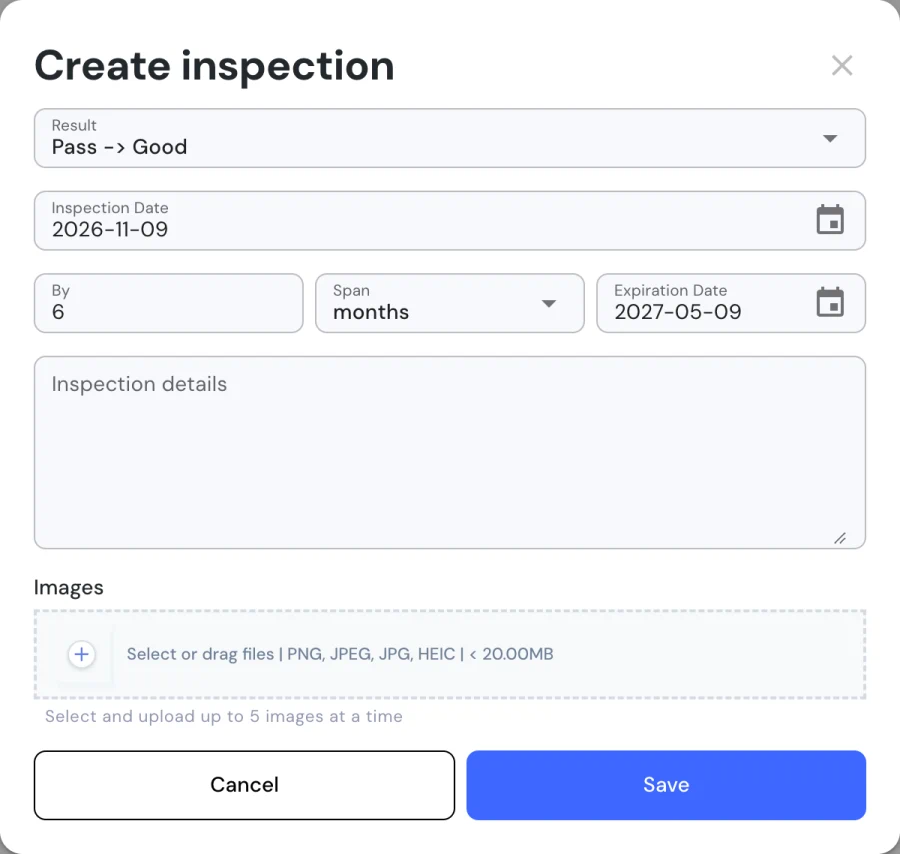
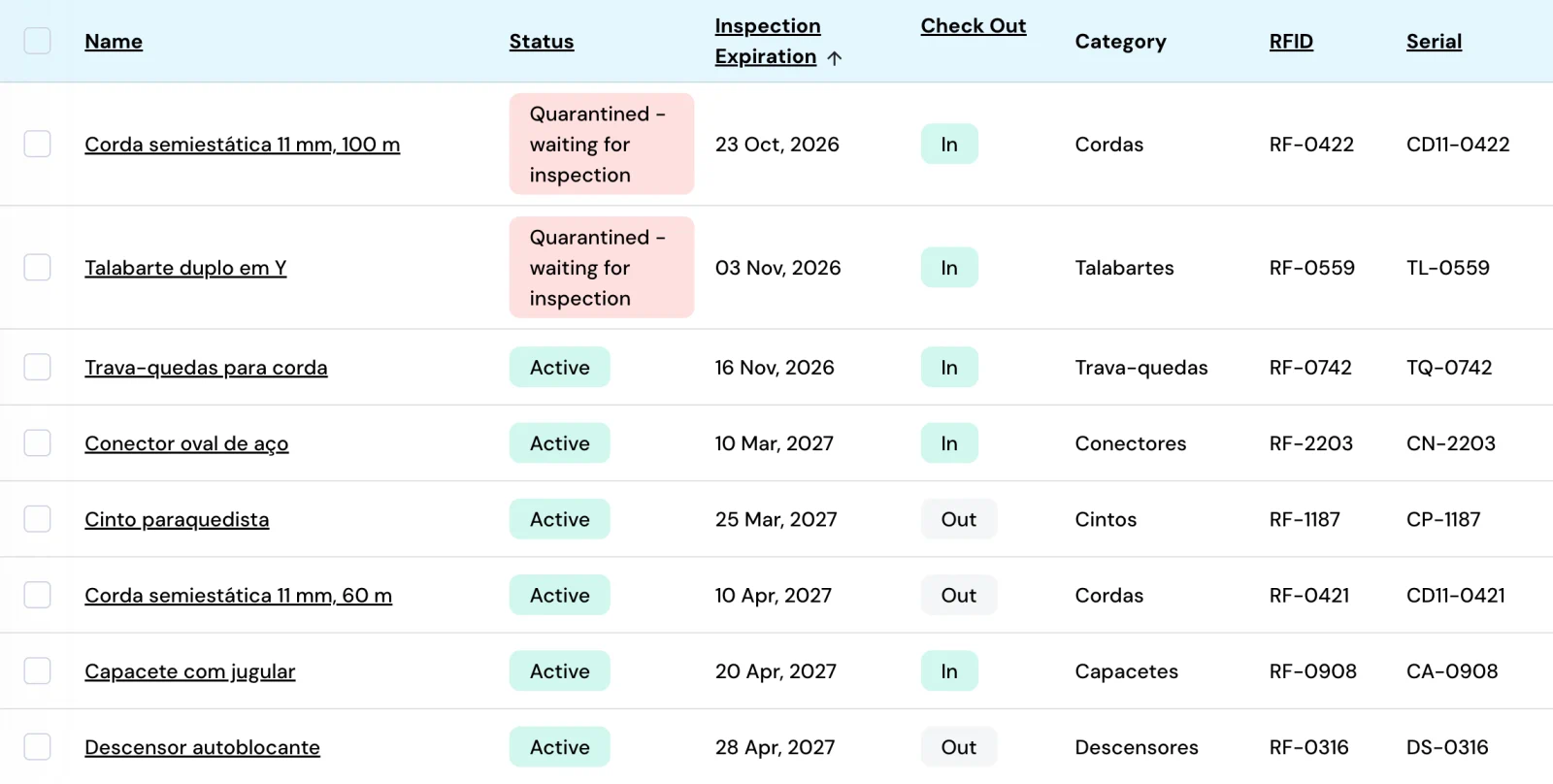
- Inspection: you set the inspection interval, such as the 6 months in Annex I. When it expires, the item goes into quarantine automatically.
- Technician documents: the system warns you before a certificate or ASO expires and highlights anyone with an expired document.


- Rope hours: the app records rope access hours, which helps keep the DRAPC or logbook up to date.
- Traceability: each item has its own ID, with RFID and NFC tags, and is linked to the job and the technician who checked it out.
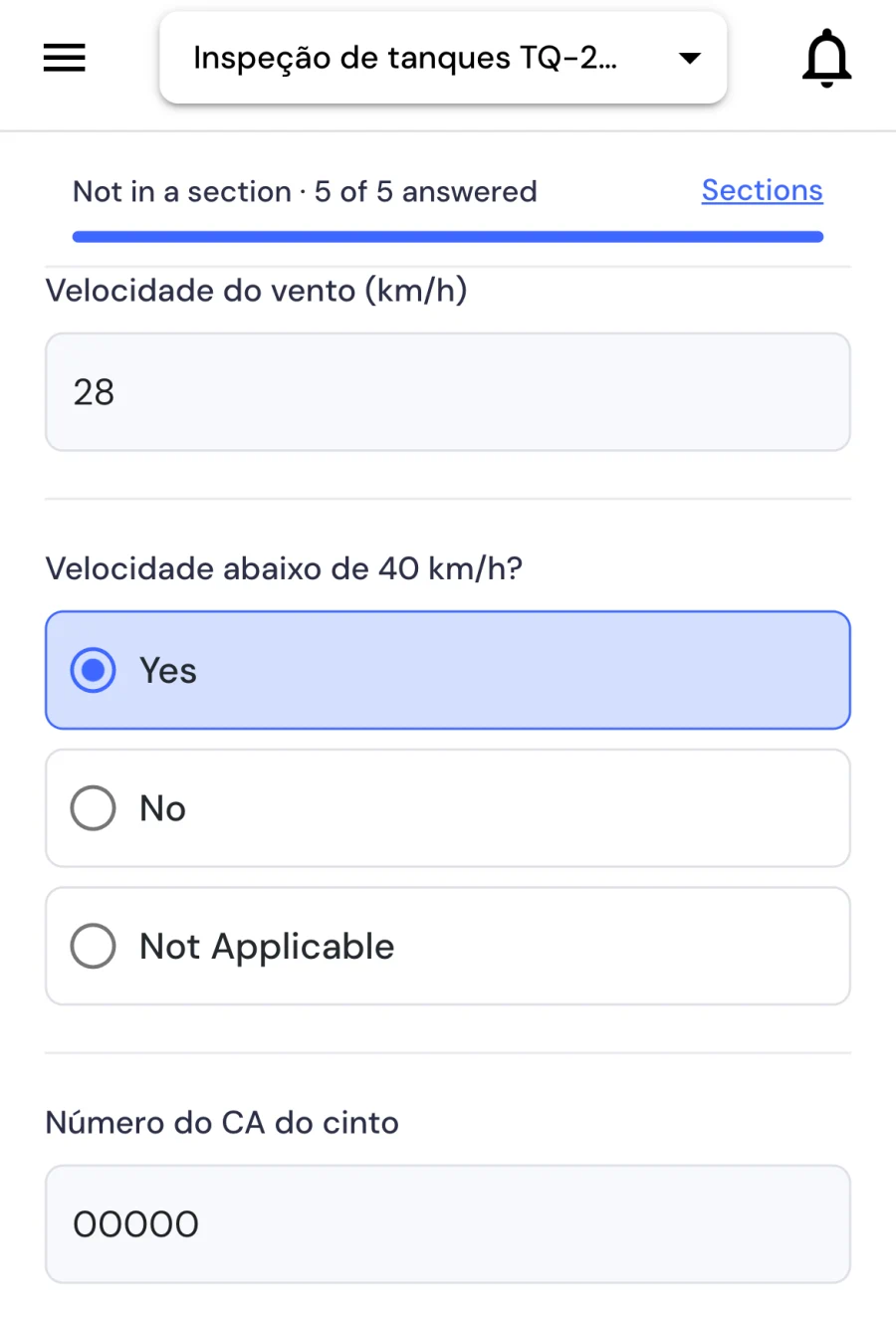
- Forms: each company builds its own, such as Risk Analysis, Work Permit, CA control and wind measurement, and the team fills them in on a phone, even offline.
- Signature: technicians and clients sign on the phone screen. This signature does not use an ICP-Brasil digital certificate. If a document calls for another format, the app generates the PDF with or without a signature field, so it can be signed by hand or on another digital signature platform. Confirm with your safety team and your client what each document requires.
- Audits and clients: reports come out ready as a PDF or a secure link, including the job’s equipment examination report.
Want to see how this would work in your operation?
See MyAbseil working on a real job
No obligation. Free onboarding included.
This content is for information only. It does not replace advice from an occupational safety professional or reading the current standards.
Sources
- NR-35 with changes up to October 2025 (FIEP-PR)
- Manual for the Rope Access Annex of NR-35 (Ministry of Labor, 2014)
- ABENDI: rope access certification
- ABNT NBR 15475, 2007 edition (copy)
- IRATA: ICOP
- IRATA: equipment inspection topic sheet (2024)
- IRATA: ISO/IEC 17024 accreditation
- SPRAT: Safe Practices for Rope Access Work
- SPRAT: Rope Access Certification Requirements
- Bill 4911/2023 in the Senate and text approved by the lower house